
Creativity in Everyday Fashion Practices
by Sandra Jäger

A Method and Framework for Investigating Creativity in Fashioning Self-Identity
In everyday life and within academia there has been a tendency to believe in the "geniuses" that are the heralds of creativity (Glăveanu 2014:85). Our entire system is built on promoting this idea and that creativity flourishes in certain fields, often the arts. However, creativity is not for artistic elites, the acclaimed, or the famous. It is constantly used in everyday life; in fact, it is regarded as a normally distributed trait found in everybody to differing degrees (Jennings 2011:19), making creativity omnipresent (Boon 2014:11).
The theory of distributed creativity by Vlad Petre Glăveanu (2014). Glăveanu points not only to the social relations (We-paradigm) but also the interaction with artefacts and development over time for creative expression (Glăveanu 2014:8). The distributed approach, a cultural psychology of creativity, extends into the social and material world and conceptualizes creative action (Glăveanu 2014:81). Creative expression is possible only from within a society and culture, viewing creativity not as a "thing" but as action in and on the world (Glăveanu 2014:7-9). This means to recognize the self as an agent within an ever-changing world (Glăveanu 2014:9). This focus on the context and what people actually do when they are being creative is what informed my methodology, as well as focusing on emotion and seeking what elements constitute the possibility to be creative in everyday fashion practices.

The "Outfit of the Day Logbook" is structured as a logbook or diary, where the respondents can write down what they wear, their emotions and encounters during the day and voluntarily take pictures to accompany their outfit descriptions. The first part has questions of demography like age, gender, occupation etc. which is up to the respondents to answer if they feel comfortable doing so. Furthermore, it contains an anonymity clause and description of the purpose of the research. To keep the logbook open to interpretation and to give the respondents some freedom, each column has only suggestions of what you could write about in keyword segments. This is to keep some openness to the assignment while keeping it bound in the form that they have to fill out both description of clothes and emotions. The logbook has 14 pages for 14 days to fill out but can be used for a longer or shorter period depending on what material needs to be gathered. I had 3 respondents that used all 14 days of the logbook, which is the primary data I collected for the analysis.
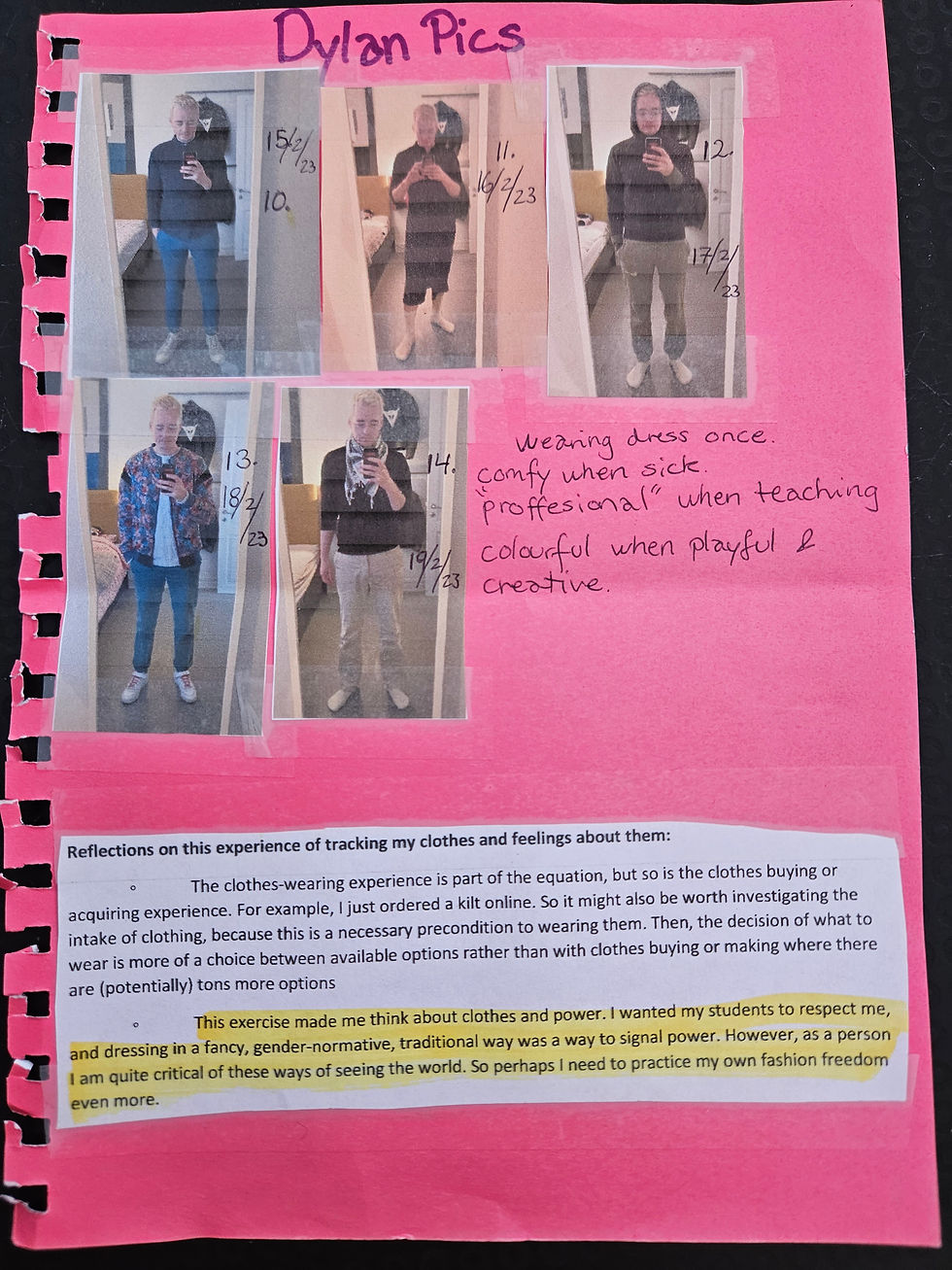
The data from each person was collected and gathered as a collage to represent the most important reflections they had. I used these collages to create keywords for each person, especially descriptive words that they used frequently to describe their feelings. Two of the respondents accompanied their descriptions with pictures, which, in the same fashion, I collected in a collage to get a complete view of what their outfit choices looked like next to each other. Analysing the logbooks, I focused on how distributed creativity theory’s sociality, materiality, and temporality affected the respondents' way of being creative. From my analysis, I formulated 7 different conditions that can limit or enable how creative one can be in their everyday fashion practice.
One of the male respondent, Dylan, took daily notes on his phone accompanied with pictures instead of the logbook itself while answering the same questions. A lot of Dylan’s clothing choices were impacted by the schedule of his day, as he accounted how his lectures or daily errands influenced his decisions. Dylan himself experiments with wearing dresses and skirts and mentioned in the logbook that he tries to not look “normal.” In his reflections he mentioned, looking back, that he would have loved to be more creative and challenging while filling out the logbook. Many of his outfits focused on looking professional, casual, and nerdy when lecturing, especially when encountering students that were new to him. He was also self-conscious wearing old shoes and feeling underdressed while going to a home design store, affected by the cultural environments and social relations around him.

The female respondent, Mette-Marie, devoted much of her logbook to expressing her emotions and struggles during the weeks. These emotional descriptions showed how much her social conditions affected her choices and creativity. As she struggled in her daily life, she either felt the need to dress colourful to gain confidence or comfortable to ease stress. Her descriptions of the clothes always included age and damage, which the other respondents did not focus on, showing how she is more concerned about the duration of what she wore. Similar to the other respondents, she chose her clothes based on the people she was meeting and the culture she was entering, but more interestingly throughout the logbook her choices were very affected by the weather. The seasonal changes and her surroundings, such as the university classroom being cold, had detrimental effects on what she seemed able to wear. As the weather changed her energy changed, and she became more engaged with creativity and fun in wearing dresses, colours, and flowery prints. These environmental changes both in specific locations and the weather conditioned her creative process, and at the same time affected how she dealt with the other conditions whether social or cultural.
Conclusion and Further Possibilities
As the Logbook method is based both on wardrobe studies and the theory of distributed creativity, it highlights the social, emotional, and contextual elements of the individual’s accessibility to their creative potential. Furthermore, the method itself serves as a qualitative research tool that could be used interdisciplinarily as a means of investigating consumers, fashion, design, or other similar practices that concern the emotional, social, and material context of respondents. The method itself could be improved further by investigating the use of cultural probe theory and methodology (Gaver, Dunne, & Pacenti 1999), bringing more openness and playfulness in correspondence while investigating creativity through the logbook. Some respondents used the logbook more openly than scripted, which provided interesting results and therefore sparked the idea of combining the logbook method with methodology from cultural probe theory. Based on the theoretical position and the findings in the analysis, I argue for a framework to investigate the freedom of creativity in everyday fashion practices. Much like the theory of distributed creativity, I identified seven contextual conditions that have the potential of enabling or limiting the freedom to engage with one’s creativity, in this case specifically within fashion practices.
Conditions of Limitation and Enablement in Creativity:
o Bodily
o Material
o Economic
o Social
o Societal/Political
o Cultural
o Environmental
Each condition differs in the degree of its effect and is potentially impacted by having interdependence with other conditions, thus enabling or limiting freedom to creatively fashion oneself. With further analysis, this framework could be developed and extended to domains other than fashion, where it would be useful to access the conditions of creativity.
Overall, the research gathered an insight into the importance of creativity within fashion practices as we use clothes to fashion our self-image. The analysis clearly showed that there are both internal and external conditions that affect how freely respondents feel they can be creative. Especially contextual conditions, such as culture, social, and societal conditions, limit or enable how much courage the respondents have to experiment with their style and therefore how creative they are in their everyday fashion practices. As much as the weather, materials, and our bodies affect our choices, it is also the culture that surrounds us, the people we meet or socialise with, and the values and symbols of society that critically condition the limitation or enabling of creativity for fashion choices. Understanding these conditions may also grant us the knowledge to challenge what is limiting us, thereby enabling us to become more creative and have the freedom to express our self-identity.
Bibliography
Boon, W. (2014). Defining creativity. Amsterdam: BIS Publishers.
Fletcher, K., & Klepp, I. G. (2017). Opening up the wardrobe: A methods book. Bollington: Novus Press.
Gaver, B., Dunne, T., & Pacenti, E. (1999, Jan/Feb). Cultural Probes. Interactions, 6(1).
Gilbert, E. (2015). Big magic: Creative living beyond fear. New York: Riverhead.
Glăveanu, V. P. (2014). Distributed creativity: Thinking outside the box of the creative individual. Aalborg: Springer.
Jennings, T. (2011). Creativity in fashion design: An inspiration workbook. New York: Fairchild Books.
Smit, I., & van der Hulst, A. (2018). Creativity takes courage: Dare to think differently. New York: Workman Publishing.
Bio
Sandra Jäger completed her BA in Design Culture and Economics and MA in Design Studies at the University of Southern Denmark (SDU) with a focus on critical fashion studies, gender studies, and sustainability. She is the former Editor in Chief of The Critical Pulse magazine, as well as a contributing writer, editor, illustrator, and project manager. Her other work includes graphic design, museum guided tours, and teaching. She is currently teaching fashion and design at SDU.


Kommentarer